When Breakfast Goes Horribly Wrong
Imagine waking up one morning to find your neighbor's pig digging through your potato garden. Annoying? Sure. Worth starting an international war? Probably not. But in 1859, that's exactly what nearly happened on San Juan Island, a small piece of land floating in the waters between Washington Territory and British Columbia.
Lyman Cutlar, an American farmer, had dealt with this particular pig problem before. The hog belonged to Charles Griffin, a British subject working for the Hudson's Bay Company. On June 15, 1859, Cutlar had finally had enough. He grabbed his rifle and shot the pig dead.
What happened next would make diplomatic historians shake their heads for generations.
The Island Nobody Could Agree On
San Juan Island sat in a legal gray area that would make any property lawyer nervous. The 1846 Oregon Treaty between Britain and the United States had established the 49th parallel as the border, but it got fuzzy when it came to the islands scattered throughout the Strait of Georgia. The treaty mentioned that the border should follow "the channel which separates the continent from Vancouver's Island," but nobody bothered to specify which channel.
There were two main waterways, and depending on which one you chose, San Juan Island belonged to either the Americans or the British. Both sides had been quietly ignoring this problem for over a decade, with American settlers and British Hudson's Bay Company employees living side by side in an uneasy peace.
Until one pig ruined everything.
From Pork Chops to Gunboats
After shooting the pig, Cutlar offered Griffin $10 in compensation. Griffin demanded $100. When Cutlar refused, Griffin threatened to have him arrested by British authorities. This is where things got spectacularly out of hand.
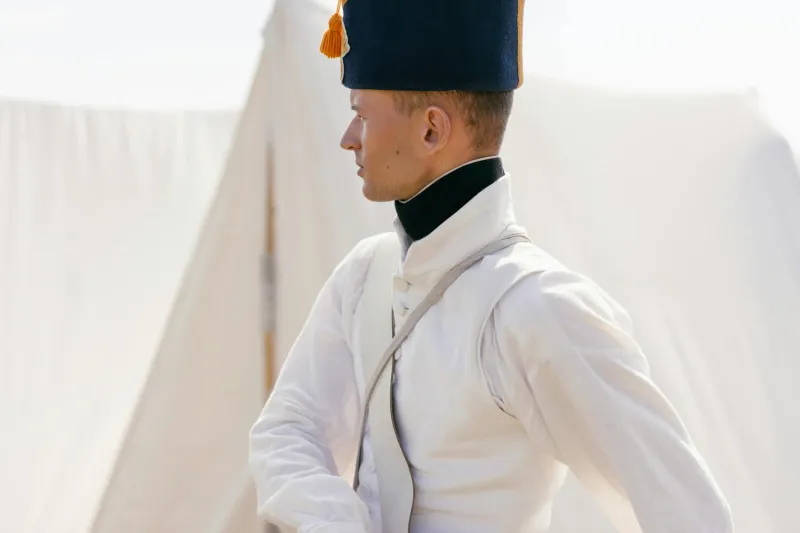
Cutlar appealed to American officials, claiming he was being harassed on American soil. The local U.S. military commander, General William S. Harney, decided this was clearly a matter of national sovereignty and dispatched Captain George Pickett (yes, the same Pickett who would later become famous for his charge at Gettysburg) with 64 soldiers to protect American interests.
The British weren't about to be outdone. They sent three warships carrying 2,140 men and 70 guns to the island.
Suddenly, a dead pig had become an international incident involving nearly 3,000 armed men facing off across a small island that most people couldn't find on a map.
The World's Most Civilized Standoff
What followed was perhaps the most polite military confrontation in history. British Rear Admiral Robert Baynes arrived to assess the situation and reportedly told the local British commander, "Tut, tut, no, no, the damned fools, not going to involve two great nations in a war over a pig."
Meanwhile, both sides continued to reinforce their positions. The Americans eventually had 461 men on the island, while the British maintained their naval superiority offshore. For months, soldiers from both nations stared at each other across earthwork fortifications, occasionally sharing drinks and playing sports together when their officers weren't looking.
The absurdity wasn't lost on anyone involved. Newspapers on both sides of the Atlantic began calling it the "Pig War," and editorial cartoons mocked the idea of two civilized nations nearly coming to blows over livestock.
When Cooler Heads Finally Prevailed
President James Buchanan, already dealing with the looming Civil War, sent General Winfield Scott to defuse the situation. Scott negotiated a joint occupation agreement: both nations would station small forces on the island until the boundary dispute could be formally resolved.
This arrangement lasted for 12 years. American and British soldiers lived peacefully side by side, with their biggest conflicts involving disputes over who had to patrol in the rain. The only casualty of the entire Pig War was, ironically, the pig itself.
The Final Verdict
In 1871, both nations agreed to let German Kaiser Wilhelm I arbitrate the boundary dispute. After reviewing maps, treaties, and testimonies, the Kaiser ruled in favor of the United States. On November 25, 1872, the British flag was lowered on San Juan Island for the last time, and the Americans took full control.
Charles Griffin, the pig's owner, never did get his $100.
Why This Matters More Than You'd Think
The Pig War might sound like a historical comedy sketch, but it actually demonstrated something remarkable about 19th-century diplomacy. Two nations with a history of conflict managed to avoid war over a genuinely disputed territory through patience, negotiation, and the occasional shared bottle of whiskey between enemy soldiers.
Today, San Juan Island National Historical Park preserves both the American and British camps, serving as a monument to the time when international relations nearly went to hell over a hungry hog. Visitors can walk through the earthworks where soldiers once prepared for a battle that never came, all because two neighbors couldn't agree on livestock management.
Sometimes the most unbelievable part of history isn't what happened—it's what almost happened over something completely ridiculous.