The Space Rock That Crashed Into Legal History — And Started a Property War

When the Universe Literally Came Calling
Ann Hodges was having a perfectly ordinary afternoon nap on November 30, 1954, when the universe decided to personally introduce itself. She was lying on her couch in Sylacauga, Alabama, when a grapefruit-sized chunk of space rock crashed through her roof, bounced off her radio, and smacked her in the thigh.
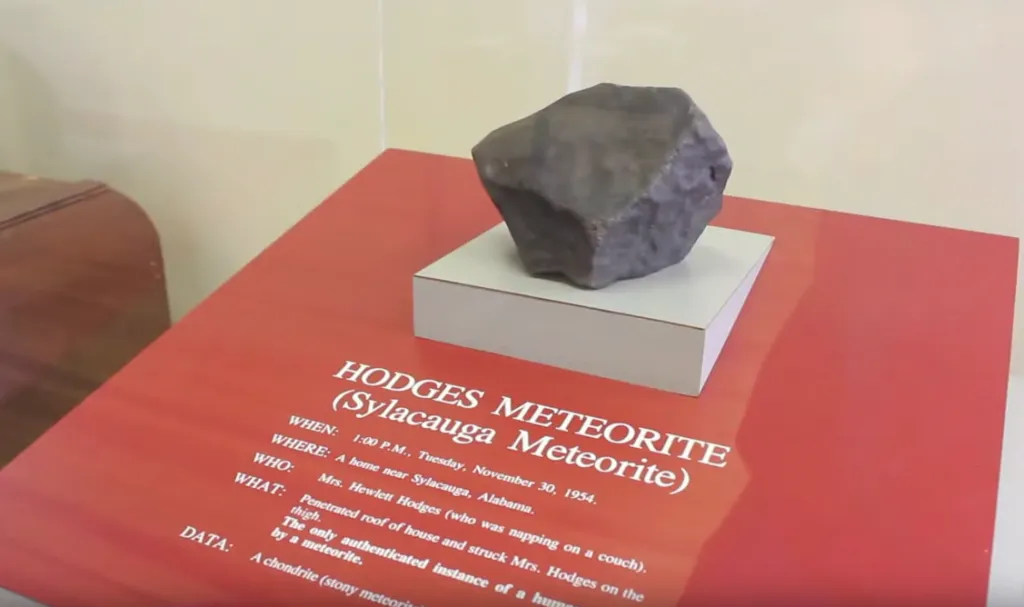 Photo: Ann Hodges, via 4.bp.blogspot.com
 Photo: Sylacauga, Alabama, via cdn-assets.alltrails.com
Congratulations, Mrs. Hodges: you just became the first human being in recorded history to be struck by a meteorite. Unfortunately, that cosmic distinction was about to trigger the weirdest property dispute in American legal history.
The Rock That Broke More Than Just a Roof
The 8.5-pound meteorite left Ann with a spectacular bruise and a house full of debris, but those were the least of her problems. Within hours, her small Alabama town was swarming with scientists, reporters, curiosity seekers, and — most ominously — lawyers.
The question that nobody had ever needed to ask before suddenly became urgent: when a rock falls from outer space and hits someone, who actually owns it?
Ann figured it was pretty straightforward. The thing had literally struck her body and crashed through her roof. If that didn't establish ownership, what would? But her landlord, Bertie Guy, had other ideas. He claimed the meteorite belonged to him because it had damaged his property. Meanwhile, the local sheriff seized the rock as "evidence" while everyone argued about what crime, if any, had been committed.
Welcome to Space Law, 1954 Edition
The legal battle that followed was unprecedented because, frankly, nobody had written laws covering cosmic debris hitting people. Property law assumes things come from Earth. Insurance policies don't typically include "acts of the solar system" clauses. And courts had never needed to determine whether space rocks follow the same ownership rules as, say, a baseball that lands in your yard.
Lawyers dove into ancient maritime law, mining rights, and property precedents, trying to find something — anything — that might apply to a situation involving interplanetary real estate. They discovered that American law was surprisingly unprepared for the space age, even though Sputnik was still three years away.
The case attracted national attention partly because it was so bizarre, but also because everyone realized this wouldn't be the last time space junk would crash into Earth. If they didn't figure out the legal framework now, every future meteorite strike would trigger the same chaos.
The Universe's Most Expensive Bruise
While lawyers argued and reporters camped out in her yard, Ann Hodges found herself trapped in a nightmare of legal limbo. The meteorite — her meteorite, as she saw it — was locked away as evidence while strangers debated her right to own the thing that had literally assaulted her.
The stress was overwhelming. Ann had never asked to become famous, and she certainly hadn't requested a cosmic collision. She just wanted the rock that had marked her place in history, and maybe enough money from selling it to cover her medical bills and roof repairs.
Meanwhile, the scientific community was going crazy trying to study the meteorite. It was a rare chondrite that had traveled millions of miles through space before finding Ann's living room. Researchers wanted to slice it up for analysis, but they couldn't touch it while the ownership dispute raged.
The Settlement That Settled Nothing
After months of legal wrangling, Ann and her landlord finally reached a settlement. She would pay Bertie Guy $500 for his claim to the meteorite, making her the undisputed owner of the rock that had struck her.
But by then, the whole ordeal had soured the experience. The meteorite that should have been Ann's ticket to fame and fortune had become a source of stress and financial strain. When she finally tried to sell it, she discovered that the legal battle had actually decreased its value — collectors were wary of buying something with such a complicated ownership history.
Ann eventually donated the meteorite to the Alabama Museum of Natural History, where it remains today. She never made the money she'd hoped for, and the cosmic lottery ticket that had literally fallen into her lap became more of a burden than a blessing.
 Photo: Alabama Museum of Natural History, via bunny-wp-pullzone-5vqgtgkbhi.b-cdn.net
The Legal Precedent That Nobody Wanted
The Hodges case established several important legal precedents that courts still reference today. It confirmed that meteorites follow the same property laws as terrestrial objects — if space debris lands on your property, you own it, assuming you own the property. But it also revealed huge gaps in how the law handles extraterrestrial materials.
More importantly, the case highlighted how unprepared society was for the space age. In 1954, the idea of things regularly falling from space seemed like science fiction. Today, with satellites, space junk, and private space companies, the legal questions that plagued Ann Hodges have become routine concerns.
The Cosmic Lottery Nobody Wants to Win
Ann Hodges died in 1972, but her place in history is secure. She remains the only person confirmed to have been struck by a meteorite, a distinction that's both fascinating and slightly terrifying.
Her story reveals something profound about how the law struggles to keep up with reality. When the universe literally comes knocking, our legal system — designed for earthbound disputes — suddenly seems quaint and inadequate.
Today, space law is a growing field, with lawyers specializing in everything from satellite collisions to asteroid mining rights. It all started with a woman taking a nap in Alabama and a rock that traveled farther than most people ever will, just to give her the universe's most expensive bruise.