
When Time Becomes a Matter of Opinion
Time is supposed to be simple. The sun rises, the sun sets, and somewhere in between, you show up for work. But in the early 1900s, the residents of Harmony Station, Indiana, discovered that time could be surprisingly negotiable.
 Photo: Harmony Station, Indiana, via www.midwestliving.com
The trouble started in 1918 when Congress passed the Standard Time Act, carving America into neat time zones with crisp, logical boundaries. Unfortunately, nobody told the mapmakers that Harmony Station existed.
The federal time zone line ran directly through the center of town, splitting Main Street like an invisible river. The post office sat on Eastern Time. The general store operated on Central Time. And the residents found themselves living in a temporal no-man's land where punctuality became a philosophical question.
The Practical Problem with Impractical Boundaries
Harmony Station wasn't just split by accident—it was split with mathematical precision. The town's 847 residents lived within a half-mile radius, but depending on which side of Main Street you called home, you were either an hour ahead or an hour behind your neighbor.
Postmaster William Henley faced the first crisis. Federal regulations required the post office to operate on Eastern Time, but most of his customers lived on Central Time. When he opened at 8 AM Eastern, it was 7 AM for two-thirds of his clientele. When he closed at 5 PM Eastern, people rushing to mail letters found themselves an hour late.
 Photo: William Henley, via i.ebayimg.com
"I was turning away customers who thought they had plenty of time," Henley later wrote to his supervisor in Indianapolis. "And I was opening to empty streets because folks thought I was closed."
Meanwhile, store owner Margaret Sullivan faced the opposite problem. Her customers expected her to operate on local time—Central Time—but her business correspondence with suppliers in the Eastern Time zone created constant confusion about delivery schedules and payment deadlines.
The Ingenious Solution
Instead of petitioning Washington to redraw the time zone boundaries (a process that could take years), the residents of Harmony Station decided to redraw reality.
They would simply operate on both times simultaneously.
The post office would maintain its federally mandated Eastern Time schedule for all official business. But Henley would also post Central Time hours for local customers. His solution was elegant: two sets of business hours, two clocks on the wall, and a handwritten sign explaining which time zone applied to which transaction.
Sullivan went even further. She operated her general store on Central Time but conducted all postal business (she also sold stamps and money orders) on Eastern Time. Customers learned to check both clocks before asking about services.
The local bank split the difference, opening at 9 AM Central/10 AM Eastern and closing at 4 PM Central/5 PM Eastern, ensuring they were always open during business hours in both time zones.
The Federal Headache
This practical solution created a bureaucratic nightmare for federal agencies trying to regulate a town that technically existed in two different times.
Railway schedules became exercises in creative interpretation. The Chicago & Eastern Illinois Railroad printed timetables showing Harmony Station stops in both time zones, with a footnote explaining that passengers should "consult local authorities regarding actual departure times."
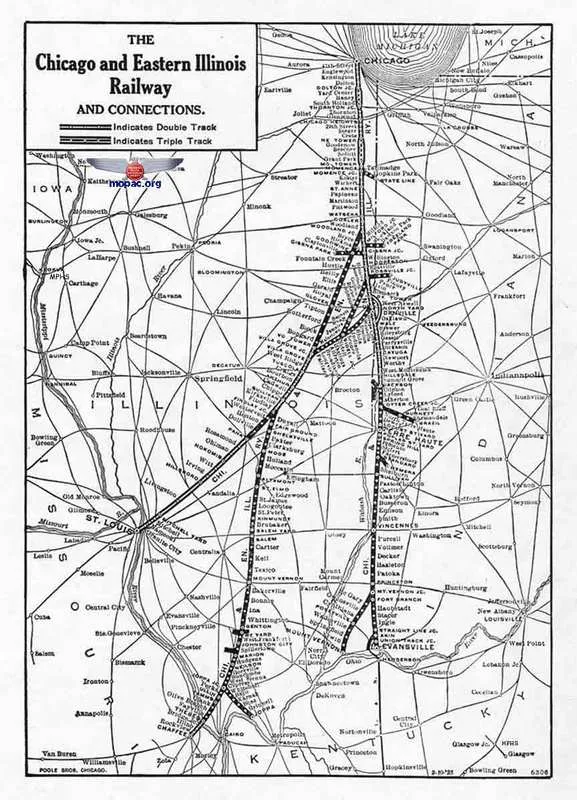 Photo: Chicago & Eastern Illinois Railroad, via cbrandt.com
Tax collection turned surreal. The IRS insisted on Eastern Time for all federal deadlines, while state tax authorities operated on Central Time. Residents learned to file their returns twice—once for each time zone—just to be safe.
Election administration became particularly complex. Voting was supposed to close at 6 PM "local time," but nobody could agree what local time meant. Election officials solved this by keeping polls open until 6 PM in both time zones, effectively extending voting hours by sixty minutes.
The Correspondence That Changed Everything
By 1925, the dual-time arrangement had created so much confusion that the Postmaster General's office launched an investigation. Inspector Harold Morrison was dispatched to Harmony Station with orders to "resolve the temporal irregularities" disrupting mail service.
Morrison arrived expecting to find chaos. Instead, he discovered a community that had quietly solved a federal bureaucracy problem through pure common sense.
"The system works," he reported back to Washington. "Mail is delivered efficiently, customers are satisfied, and federal regulations are technically being followed. I recommend we leave well enough alone."
But Morrison's supervisor disagreed. The Postal Service demanded a single, consistent time zone for all operations. Either Harmony Station would operate entirely on Eastern Time, or the post office would be relocated to the Eastern Time side of town.
The Government Gives In
Faced with the prospect of moving their post office—and losing the federal jobs that kept their small economy afloat—Harmony Station residents did something unprecedented: they lobbied Washington to change the time zone boundary.
Their petition, signed by every adult resident, made a compelling case. Moving the boundary just two miles west would place the entire town in the Central Time zone without affecting any other communities. The change would eliminate bureaucratic confusion while preserving local jobs.
After eighteen months of congressional review, the boundary was officially moved in 1927. Harmony Station became entirely Central Time, ending nearly a decade of temporal confusion.
The Legacy of Living in Two Times
The Harmony Station time zone saga reveals something remarkable about American pragmatism: when federal policy collides with local reality, communities often find ways to make both work.
For nine years, residents of Harmony Station proved that time itself could be negotiable when necessity demanded it. They created a functioning dual-time economy that satisfied federal regulations while serving local needs.
Today, the town (now called Harmony) operates entirely on Central Time. But longtime residents still remember the era when punctuality required checking two clocks and asking which century you were living in.
The old post office building still displays both clocks on its wall—a monument to the years when time was more suggestion than rule. And every so often, visitors notice the peculiar setup and ask why a small Indiana town needs to know what time it is in two different zones.
The answer, locals explain with a smile, is simple: because sometimes the government makes time more complicated than it needs to be.
And sometimes, the only solution is to live in yesterday and tomorrow at the same time.