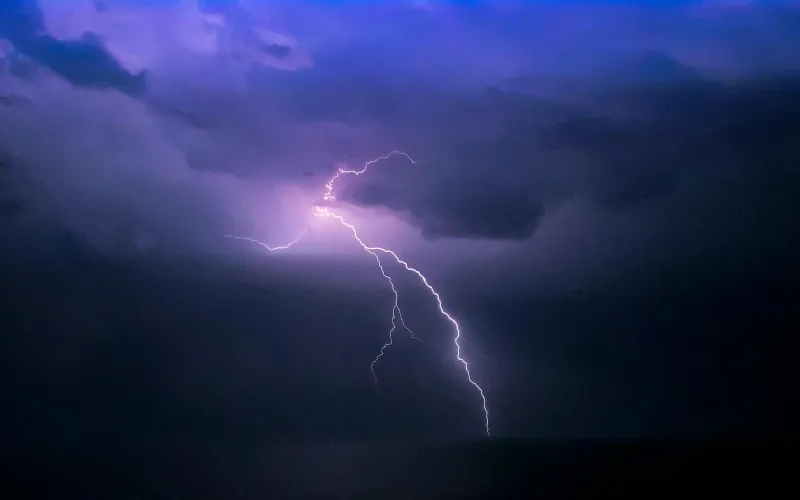
The Weatherman Who Saw Too Much
Most meteorologists predict the weather. Dr. Harold Wickham predicted his own death — with disturbing accuracy.
For fifteen years, this obsessive National Weather Service forecaster tracked what he called "the anomaly," a recurring atmospheric pattern that appeared over the Midwest every few years. Wickham became convinced this pattern would eventually generate a catastrophic storm directly over his hometown of Cedar Rapids, Iowa. He even predicted the type of day it would happen: a humid Tuesday in mid-June.
 Photo: Cedar Rapids, Iowa, via clan.fastly.steamstatic.com
On June 15, 1963 — a humid Tuesday in mid-June — Wickham was struck and killed by lightning while fishing on the Cedar River, during a freak storm that meteorologists still can't fully explain.
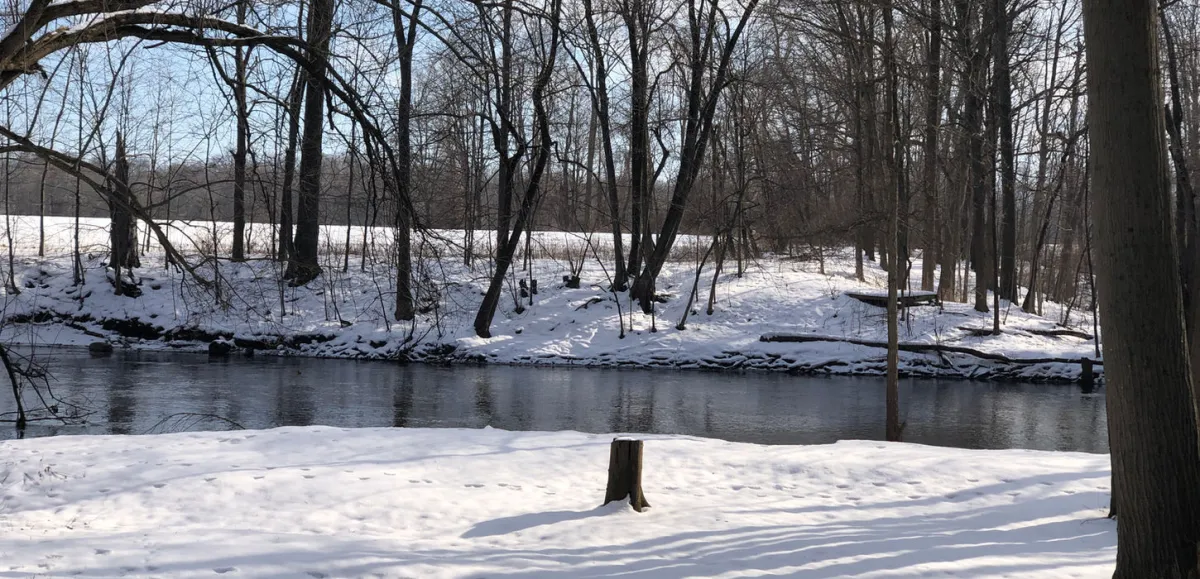 Photo: Cedar River, via static.wixstatic.com
The Birth of an Obsession
Wickham's fascination with "the anomaly" began in 1948, when he noticed an unusual barometric pressure pattern appearing on weather maps across Iowa, Illinois, and Missouri. The pattern resembled a slow-moving spiral that would form, dissipate, and reform in a roughly triangular area every 18 to 24 months.
Most of his colleagues dismissed it as statistical noise — random variations in atmospheric pressure that meant nothing. But Wickham was convinced he'd discovered something significant. He started keeping detailed logs, mapping each occurrence with obsessive precision.
"Harold would spend hours staring at those weather maps," recalled his colleague Janet Morrison. "He'd trace that spiral pattern with his finger like he was trying to decode some kind of message from the sky."
The Prophecy Takes Shape
By 1955, Wickham had documented 12 instances of the anomaly. He noticed that each occurrence was slightly stronger than the last, and the spiral was gradually tightening around a specific geographic point: Cedar Rapids, where he lived with his wife and two children.
Wickham began making increasingly specific predictions. In a 1958 presentation to the American Meteorological Society, he declared that the anomaly would eventually "converge into a singular atmospheric event of unprecedented intensity" over Cedar Rapids. He predicted it would happen on a Tuesday, between June 10th and 20th, during a year when humidity levels exceeded seasonal averages.
The presentation was met with polite skepticism. Dr. Robert Chen, who attended the talk, later wrote: "Wickham's data was meticulous, but his conclusions seemed to leap beyond what the evidence supported. He was treating weather patterns like prophecy."
The Warning Signs
As the 1960s began, Wickham's predictions grew more ominous. He started carrying a barometer everywhere, obsessively checking pressure readings. His wife, Dorothy, later told reporters that he would wake up in the middle of the night to check weather reports, muttering about "convergence patterns" and "atmospheric destiny."
In early 1963, Wickham detected what he believed were the final signs. The anomaly had appeared three times in rapid succession — January, March, and May — each time stronger and more focused on Cedar Rapids. He calculated that the next occurrence would be "the event" he'd been tracking for fifteen years.
Wickham made his final prediction in the June 10th edition of the Cedar Rapids Gazette: "The anomaly will reach critical convergence between June 14th and 16th. I expect unprecedented atmospheric violence directly over our city. Citizens should prepare for severe weather conditions."
The Day of Reckoning
June 15, 1963 dawned humid and still — exactly the conditions Wickham had predicted. Despite his own warnings, he went fishing on the Cedar River, something he did every Tuesday after his morning weather briefing.
At 2:47 PM, a storm cell formed directly over Cedar Rapids with unusual speed. Within minutes, it had intensified into what meteorologists later classified as a "micro-supercell" — an extremely rare phenomenon where a tiny area experiences hurricane-force conditions while surrounding areas remain calm.
Wickham was found on the riverbank at 3:15 PM, killed instantly by a lightning strike. The storm dissipated within twenty minutes, leaving no other casualties or significant damage. Weather stations recorded the most intense barometric pressure drop in Iowa history — lasting exactly 28 minutes.
The Uncomfortable Silence
What happened next was almost as strange as Wickham's death itself: the meteorological community went quiet.
The National Weather Service conducted a routine investigation but classified the findings. Wickham's fifteen years of anomaly research mysteriously disappeared from the agency's archives. His colleagues were instructed not to discuss his predictions publicly.
"There was definitely pressure to keep quiet about Harold's work," admitted Dr. Morrison years later. "Nobody wanted to deal with the implications of a meteorologist who accurately predicted his own death using weather patterns."
The Whispered Legacy
Today, Wickham's story circulates quietly among weather professionals as one of meteorology's most unsettling cases. Some dismiss it as an elaborate coincidence — a troubled man who made enough predictions that one was bound to come true. Others wonder if Wickham discovered something about atmospheric patterns that science still doesn't understand.
Dr. Elena Rodriguez, who studied historical weather anomalies at NOAA, put it best: "The Harold Wickham case represents either the most remarkable coincidence in meteorological history, or proof that our understanding of atmospheric science has some very uncomfortable gaps."
When Science Meets the Unexplained
Perhaps the most disturbing aspect of Wickham's story isn't that he predicted a freak storm — it's that he predicted it would kill him specifically. His final journal entry, found after his death, read: "The anomaly doesn't just forecast weather. It forecasts fate. I've been tracking my own ending for fifteen years."
Whether Wickham was a brilliant scientist who discovered hidden patterns in chaos, or a troubled man whose obsession created a self-fulfilling prophecy, remains an open question. What's undeniable is that he spent fifteen years predicting something impossible — and then lived to see it happen exactly as he said it would.
In the end, Harold Wickham became the only meteorologist in history whose final forecast was his own obituary.