A Desert Swallowed Itself and Created a Lake Overnight — Then the Lawyers Showed Up
There Was Sand. Then There Was Water.
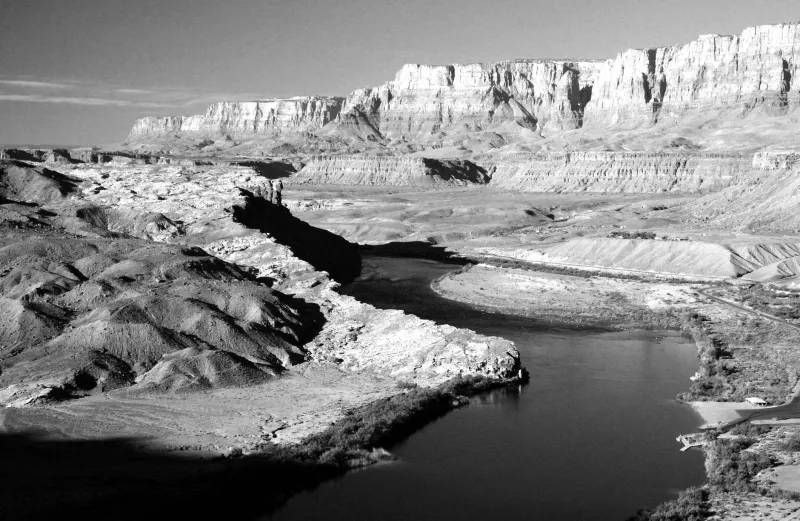
Picture a stretch of flat, sun-baked desert in the American Southwest. The kind of landscape where nothing much changes for centuries — scrub brush, cracked earth, the occasional hawk overhead. Now picture waking up one morning to find a lake sitting in the middle of it.
Not a puddle. Not seasonal flooding. A lake.
That's roughly what happened in 2016 when a massive underground aquifer beneath the region experienced what hydrologists would later describe as a catastrophic subsidence event — essentially, the ground gave way, and the water beneath it surged upward to fill the void. Within days, a body of water had materialized where desert had existed for as long as anyone could remember.
It was genuinely beautiful. It was also immediately, spectacularly controversial.
Two States, One Accidental Lake
The problem with surprise geography is that it doesn't come with paperwork. State boundaries in the American West were drawn long before satellite imaging, and they were often defined by landmarks — rivers, ridgelines, surveyor pins — that assumed the landscape would stay roughly where it was.
When the lake appeared straddling a contested stretch of borderland between two states, both governments did what governments do: they claimed it.
The arguments were immediate and, depending on your tolerance for bureaucratic theater, either fascinating or exhausting. One state argued that the water source — the aquifer — lay predominantly within its territory, making the lake a natural extension of its resources. The other contended that the surface area of the water body fell largely within its jurisdiction, and surface rights were what mattered.
Environmental advocacy groups added their own layer of complexity, petitioning for protected status for what they were already calling an ecological miracle. Desert lakes, even temporary ones, attract migratory birds within weeks. Certain amphibian species that spend decades in dormancy can detect water from remarkable distances and make their way to new sources with startling speed. The lake was already becoming a habitat before anyone had finished arguing about who owned it.
Federal agencies were looped in. Lawyers were retained. Maps were redrawn on whiteboards in conference rooms across two state capitals.
Then the Scientists Showed Up and Ruined Everything
Hydrologists studying the aquifer collapse delivered findings that reframed the entire dispute almost immediately.
The lake, they explained, was draining.
Not dramatically — not a bathtub with the plug pulled. Slowly, measurably, and almost certainly irreversibly. The same subsidence event that had forced the water upward had also fractured the underlying rock structure in ways that were now allowing the water to percolate back down into deeper geological layers. The lake had no sustainable inflow. It had no outlet to manage. It was, in the clinical language of the report, a transient hydrological feature.
In plain English: the lake was temporary, and there was nothing anyone could do about it.
The projected timeline for complete disappearance ranged from two to seven years depending on rainfall and temperature. The legal battles over water rights — which had already consumed considerable resources — were now battles over something that would cease to exist before any court ruling could take effect.
The Ecological Window
What the legal chaos obscured was the genuinely remarkable ecological story unfolding on the ground.
Desert lakes, even short-lived ones, function as critical waypoints in the American West's increasingly stressed water systems. Migratory birds use them as rest stops along flyways that have been disrupted by drought and development. Certain native fish species, transported deliberately or accidentally, can establish in new water bodies within a single season.
Researchers scrambled to document the lake's ecology before it vanished, treating it less as a legal problem and more as a rare natural experiment. What happens when you drop a lake into a desert? What colonizes it first? How quickly does a functional ecosystem assemble itself when the conditions are suddenly right?
The answers, it turned out, were surprising. The lake attracted species that hadn't been recorded in the region in decades. It temporarily raised the local water table enough to green up surrounding vegetation. It became, briefly, a small island of biological activity in an otherwise desiccated landscape.
What a Disappearing Lake Teaches Us About Water Law
The legal aftermath of the lake's appearance — and its slow disappearance — exposed some genuine gaps in how Western water law handles dynamic or temporary features.
Most water rights frameworks in the American West were designed for rivers, streams, and established groundwater sources. They assume a certain permanence. A lake that materializes, exists for a few years, and then drains back underground doesn't fit neatly into any existing category.
Some legal scholars have pointed to the episode as an argument for updating Western water law to account for the kinds of hydrological surprises that climate change is likely to produce with increasing frequency — aquifer collapses, sudden sinkholes, flash-flood lakes that persist longer than expected.
Gone Before the Gavel Fell
By the time any court was positioned to issue a meaningful ruling on the lake's ownership, the lake itself had shrunk to a fraction of its original size. The migratory birds had moved on. The legal briefs had been filed, argued, and largely mooted.
Somewhere in a state archive, there are probably still documents asserting sovereign authority over a body of water that no longer exists.
The desert, for its part, looks almost exactly as it did before. Flat, sun-baked, unchanged — except for a faint depression in the earth where the water once sat, and the memory of a very expensive argument about something that was always going to disappear.