An Oil Rig Made Land Where There Was None — Then Two Countries Spent a Decade Arguing About Who Owned the Accident
There's a version of this story that sounds like a bar bet. What happens when an oil company accidentally creates an island? Who owns it? Does it count? Can you put a flag on it?
It turns out that international maritime law has very specific answers to almost all of these questions — and that those answers, when applied to a real situation, produced one of the more quietly ridiculous territorial standoffs of the late twentieth century.
The Gulf of Mexico Has Always Been Complicated
The maritime boundary between the United States and Mexico in the Gulf of Mexico was, for most of the twentieth century, a matter of ongoing negotiation. The two countries shared a body of water that sat above enormous oil reserves, and the precise location of the line dividing American waters from Mexican waters had significant economic consequences for both sides.
The boundary wasn't fully formalized until a 2000 treaty resolved the remaining disputed zones. But in the years leading up to that agreement, the western Gulf contained areas of genuine legal ambiguity — places where both countries had overlapping claims and neither had a definitive legal advantage.
It was into one of these ambiguous zones that the accident arrived.
What the Rig Left Behind
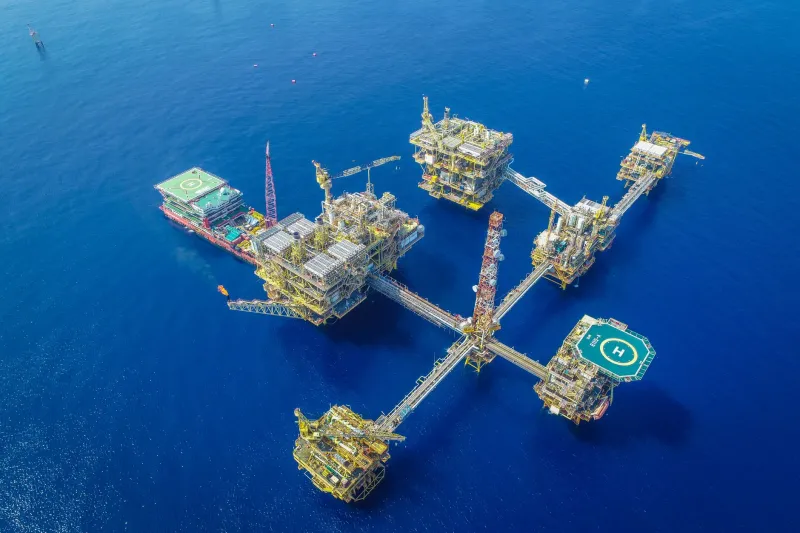
In the late 1970s and into the 1980s, offshore drilling activity in the Gulf was expanding rapidly on both sides of the informal boundary. Drilling platforms operated in deep water, anchored to the seafloor, extracting oil from reservoirs thousands of feet below the surface.
What offshore drilling can also do, under the wrong geological conditions, is destabilize the seafloor. Extracting large volumes of fluid from underground reservoirs can cause the surrounding rock and sediment to shift, compact, or collapse. In some cases, this produces subsidence — the seafloor sinks. In others, the dynamics are less predictable.
In at least one documented case in the Gulf, the combination of drilling activity, natural sediment displacement, and the physical footprint of abandoned infrastructure produced something that nobody had planned for: a shallow, semi-permanent accumulation of sediment that breached the water's surface at low tide.
It was, by most technical definitions, land.
The Question Nobody Had Prepared For
Under international maritime law — specifically the United Nations Convention on the Law of the Sea — islands and rocks that are exposed at high tide generate territorial claims. A country that owns an island owns the water around it, out to various distances depending on the feature's size and habitability. Even a tiny, barren rock can anchor a territorial claim worth billions of dollars in resource rights.
The problem was that this particular feature hadn't been there before. It was the byproduct of industrial activity. And it sat in a zone where both the United States and Mexico had arguable claims to the underlying seabed.
Mexico argued that the feature — if it qualified as land at all — sat within its continental shelf jurisdiction and therefore belonged to Mexico regardless of how it had formed. The United States countered that the sediment accumulation was too unstable and too small to qualify as an island under any reasonable legal definition, and that even if it did qualify, the relevant boundary placed it within American waters.
Meanwhile, the feature itself was doing what newly formed sediment accumulations in the Gulf tend to do: shifting, eroding, partially submerging during storm surges, and generally refusing to behave like stable geography.
The Legal Problem With Accidental Land
The deeper issue — the one that made this case genuinely interesting to maritime law scholars — was the question of whether artificially influenced land formations should generate the same territorial rights as natural ones.
The UN Convention on the Law of the Sea was written with natural geography in mind. It had provisions for artificial islands — structures deliberately built by human activity — and those provisions were clear: artificial islands don't generate territorial sea claims. But the Gulf feature wasn't quite an artificial island. Nobody had built it intentionally. It was the unplanned consequence of industrial activity interacting with natural geology.
Was it natural land that happened to have been influenced by human activity? Or was it an artificial feature that happened to look like natural land? The answer mattered enormously, because the legal consequences of each classification were completely different.
Neither country's legal teams could find a precedent that fit precisely. The dispute produced formal diplomatic correspondence, competing scientific surveys of the feature's composition and stability, and at least one academic conference paper that used the situation as a case study in the limits of existing maritime law.
How It Ended (Sort Of)
The 2000 treaty between the United States and Mexico resolved the broader boundary question in the western Gulf, and in doing so rendered the specific dispute over the accidental feature largely moot — the agreed boundary placed the area within a zone of shared management, which meant that neither country needed to win the argument in order to benefit from whatever resources the area might contain.
The feature itself had largely eroded back below the waterline by the time the treaty was signed, which some legal observers noted with a certain dry satisfaction. The thing that had started the argument had quietly ceased to exist while the argument was still going.
What remained was the legal question it had exposed: the world's territorial frameworks were built for a geography that stays where it's put. When human activity starts making new land — accidentally or otherwise — the rulebooks run out of pages faster than anyone expected.
And somewhere in the Gulf of Mexico, under a few feet of warm water, sits the sediment that made two countries argue about who owned an accident.