Authorities Showed Up to Demolish an Abandoned Town — and Found Someone Had Been Living There the Whole Time
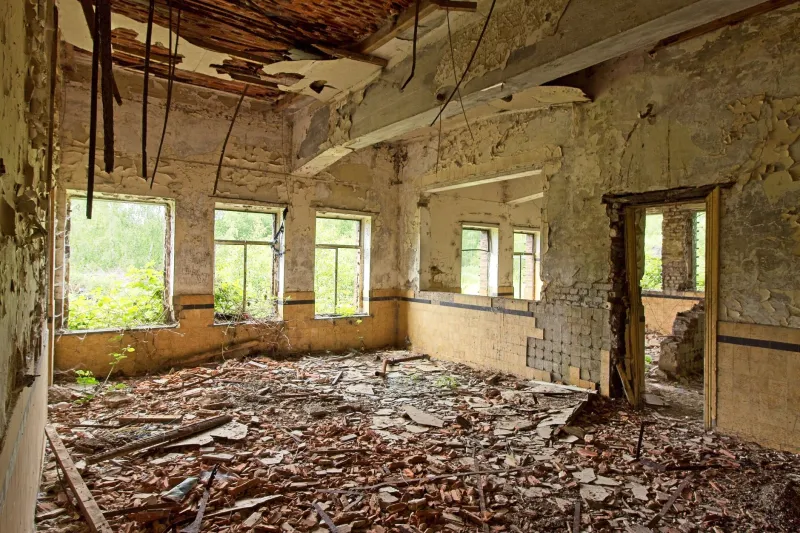
There's a particular kind of silence that settles over a place after everyone leaves. Ghost towns have it. Abandoned factories have it. Old resorts that ran out of money have it. It's a silence that says: nothing is here anymore. Move on.
Except sometimes, the silence is lying.
The Town That Was Supposed to Be Empty
In the mid-20th century, a number of small American communities were effectively erased — not by disaster, but by economics. Mines closed. Logging operations moved on. Company towns that had existed purely to house workers for a single industry simply stopped being necessary. The companies pulled out, the residents followed, and the buildings stayed behind to rot.
For local governments and property managers, these places were administrative headaches. They showed up in old records, sometimes carried outstanding tax liens, and occasionally attracted curiosity seekers or amateur historians. But for the most part, they were considered resolved problems. Empty. Done.
What happened in Garnet, Montana — one of the best-preserved ghost towns in the American West — offers a window into just how wrong that assumption could be.
The Last Holdout
Garnet had been a gold mining settlement since the 1860s. At its peak, it housed around a thousand people, complete with hotels, saloons, a school, and all the infrastructure of a functioning frontier community. By the 1940s, after fires and economic collapse, it had been reduced to a scattering of deteriorating wooden structures on a hillside in Granite County.
What most people didn't know — what the property records didn't reflect, what the Bureau of Land Management hadn't fully accounted for — was that at least one person had never entirely left.
For years after Garnet's official abandonment, an elderly miner named John Perkins continued to return to the site seasonally, occupying one of the remaining structures during warmer months and leaving before winter made the roads impassable. He wasn't hiding, exactly — locals in nearby Drummond knew roughly who he was. But he wasn't paying rent, wasn't on any official registry, and wasn't part of any administrative record that would have flagged his presence to the agencies nominally responsible for the land.
He was simply there. An entire human life, quietly continuing in a place that the official record had declared finished.
How Does This Actually Happen?
The mechanics of how someone disappears from bureaucratic view — while remaining physically present in a known location — are more straightforward than they might seem, and that's what makes Garnet's story so instructive.
First, there's the assumption problem. Once a location is categorized as abandoned, the people responsible for it tend to stop looking at it carefully. Inspections become infrequent. Record checks become cursory. The mental model of the place as empty becomes self-reinforcing — if you're not expecting to find anyone, you're less likely to notice signs that someone is there.
Second, there's the geography. Ghost towns don't tend to be in places with heavy foot traffic. Garnet sits at the end of a dirt road that's impassable in winter and not exactly convenient in summer. The natural isolation that made it a mining settlement in the first place also made it easy to occupy without attracting attention.
Third, and perhaps most tellingly, there's the social infrastructure — or lack of it. Perkins wasn't drawing on utilities, wasn't collecting mail, wasn't enrolled in any program that would have generated a paper trail pointing to his location. In a world where most people's existence is continuously documented by the systems they interact with, he had simply stepped outside all of those systems at once.
The Bureaucratic Blind Spot
Garnet was eventually transferred to Bureau of Land Management oversight and has since become a managed historical site, open to visitors and staffed seasonally by volunteers. The structures that remain have been stabilized. There are interpretive signs. You can take a self-guided tour.
But the story of its last unofficial resident points to something that property managers, local governments, and historical preservation organizations still grapple with: the gap between what the records say and what is actually happening on the ground.
Across the American West, there are dozens of similarly situated properties — former mining camps, logging settlements, and agricultural communities that have been administratively closed out but never physically verified. Some of them almost certainly have occupants. Some of those occupants have been there for years.
They're not ghosts. They're just people who found a gap in the paperwork and walked through it.
What It Means to Vanish in Plain Sight
There's something almost admirable about the sheer persistence required to live the way Perkins did — returning season after season to a place that the rest of the world had decided to forget, maintaining a life that existed entirely outside the systems designed to track and account for human activity.
It's also, depending on your perspective, a fairly pointed commentary on those systems. The same infrastructure that's supposed to ensure nobody falls through the cracks — property records, tax rolls, utility accounts, government registries — is also, it turns out, pretty easy to simply not be part of. You don't have to be clever about it. You just have to stop participating.
Garnet's last holdout didn't outsmart anyone. He just kept showing up to a place where nobody was looking for him.
For decades, that was enough.